How To Activate GodMode In Windows 7,8 and 10


How-to-Activate-Windows-10-God-Mode
Godmode means you can control all things from a single click. Godmode in the window gives you the ability to control all settings, features and all other important from a single place.
Mean you can see all control panel settings in a single folder, that’s a really good for every pro-internet user.
If you enable God Mode in windows you can see all control panel settings and shortcuts in one folder. This hack was first revealed in 2007 and works with all windows versions like window 7, window 8 and also on window 10.
GodMode name has nothing to do with this trick. Use your name instead of GodMode and it’ll work just fine because GodMode is just a name given to this trick as it got popular.of features.

How to Enable or Activate God Mode in Window 7, 8 and 10

  1. Make a New Folder in Your Desktop.
    Make a New Folder Godname
    Make a New Folder 
  2. Then rename the New Folder to “GodMode.{ED7BA470-8E54-465E-825C-99712043E01C}” Don’t include the quotations.
    Rename it to Godname
    Rename it to Godmode
  3. Enjoy God Mode in Your Window PC.
    God Mode in Window  7
    God Mode in Window 7
This resulting folder will give you 270 different settings and option. Use this trick every carefully and enjoy god mode in Windows.
Tuesday, September 29, 2015

Digital India Profile Pic Tool Confusion Was an Engineer’s Mistake, Facebook Says

google-mobile-app-indian-governemnt-pm-modi-digital-indiaShort Bytes: After facing widespread criticism over the tri-color profile picture tool and its relation tointernet.org, Facebook has said that it was a Facebook engineer’s mistake.
Facebook’s recent tri-color profile picture tool to show support to the Digital India initiative is facing criticism as it was claimed that the company plans to use them to show support for the controversialInternet.org initiative.
However, in an expected move, Facebook has denied the charge and called it a Facebook engineer’s mistake.
For those who don’t know, yesterday it was revealed that the source code of the Facebook page showed that these pictures were named internetOrgprofilepicture and it was said that it could be used in the future by Facebook.
Denying the claims, Facebook has said: “There is absolutely no connection between updating your profile picture for digital India and Internet.org.”
“An engineer mistakenly used the words “Internet.org profile picture” as a shorthand name he chose for part of the code. But this product in no way connects to or registers support for Internet.org. We are changing the code today to eliminate any confusion.”
The mistake has been corrected by Facebook and the picture is now named digitalIndiaProfilePicture.
However, Facebook’s explaination sound fishy as every software engineer is given a description before doing a project. The fact that the string internetOrgprofilepicture comes to his/her mind on the Digital India project couldn’t be just coincidental.
Well, the truth remains to be uncovered but it would be harmless to assume that Facebook is definitely gaining something in return of this support to Digital India campaign.
It doesn’t prove anything but it says one thing loud and clear: Mark Zuckerberg will try to prove internet.org as one of many ways in which Digital India can be achieved.

Top 10 Well Known Hacking Groups Of All Time

World’s 10 most famous hacking groups who have had most success in recent times

Like the animals, hackers also hack their prey in groups. Sometimes these groups become famous for perceived good deeds like hacking ISIS websites done by Anonymous but most of the time these hacker groups operate against the law. Some of the hacker groups have since disbanded after being in public eye. The prime example of infamous hackers group is Lizard Squad. They DDoSed the PlayStation and Xbox servers right during the time of Christmas weekend earning them many villains.
Today we are listing top such 10 most notorious hackers of all time.

1. Lizard Squad

The DDoS attack on Facebook that lowered the popular social media network as well the cyber attacks on Malaysia Airlines website that directed visitors to a page which read “404 – plane not found,” were carried out by the Lizard Squad. While Facebook refused to accept being hacked, Malaysia Airlines stated that their domain had been temporarily redirected elsewhere and that they had not been hacked. Lizard Squad has also hacked Microsoft and Sony.
The intentions of Lizard Squad look dark and gloomy due to the diverse history of their work. They are not totally computer hackers as most of the hack they do is comedy. The group is responsible for a high-profile hack of Microsoft Xbox Live and Sony’s Playstation Network. In August 2014, the group posted the ISIS flag on Sony’s servers and made other indirect references to the “cyber caliphate.” The group was arrested by the authorities in the U.S. and England after the Xbox and Playstation hacks.

2. Syrian Electronic Army

The Syrian Electronic Army claims to target political opposition groups and claims to support the Syrian President Bashar al-Assad. It calls itself “a group of enthusiastic Syrian youths who could not stay passive towards the massive distortion of facts about the recent uprising in Syria”.
It becomes involved in the use of malware, phishing, defacement, spamming, and denial of service (DDoS) attacks with often posting the Syrian flag on a victim’s website. Some have even assumed as a fact that the group is connected with the Syrian state. The group have targeted the Facebook pages and Twitter accounts of President Barack Obama and French President Nicolas Sarkozy, as well as technology companies and news organizations. Their tone is “serious and political to ironic and humorous.”

3. LulzSec

After the HBGary Federal hack of 2011, LulzSec – Lulz Security abbreviated – formed as an Anonymous spinoff. It’s slogan was “Laughing at your security since 2011.” The group announced itself with a hack against Fox.com, then Sony Pictures in 2011. The group took the CIA website offline.
LulzSec had become well known for ridiculing its victims after an attack, which made the analysts compare them to the hacks to internet pranks. In June 2011, a ‘50 days of Lulz’ statement announced that the group had fallen out. However, on July 18, the News Corporation was hacked by the group, who had posted false news about the death of Rupert Murdoch.
In 2012, the LulzSec members were arrested by the FBI after the group’s leader, Sabu, turned them in. Prosecutor Sandip Patel said the group thought of themselves as “latter-day pirates.”

4. Anonymous

“We are Anonymous. We are Legion. We do not forgive. We do not forgive…. Expect us.”
Known most for its hacking and Guy Fawkes masks, Anonymous is a decentralized open online creation group. Reports conceive that Anonymous is made up of thousands of “hacktivists.” The group has compromised religious, corporate and government websites.
The group has declared war on Scientology and hacked the Pentagon. In 2012’s Operation Payback, they also attacked MasterCard, Visa and PayPal for refusing to process payments to WikiLeaks, which in turn led WikiLeaks to choose the cryptocurrency Bitcoin. Anonymous supported Occupy Wall Street and hacked the New York Stock Exchange website in 2011.
For being involved in Anonymous, individuals have been arrested in the U.S., UK, Netherlands, Australia, Spain, and Turkey.

5. The Level Seven Crew

Rumored to be encouraged by the seventh level of hell from Dante’s Inferno, ‘the violent’ level, this hacking group hacked 60 high profile computer systems (NASA, The First American National Bank, Sheraton Hotels) in 1999. They also hacked into the US Embassy in China’s website. However, this group broke up and stopped functioning in 2000.

6. Network Crack Program Hacker (NCPH) Group

It was alleged that the NCPH Group was formed in China in 1994, whose leader Tan Dailin was apparently working for the Chinese army. It is believed that the People’s Liberation Army was funded by the NCPH. The group appears to be based out of Zigon in Sichuan Province.

7. Chaos Computer Club (CCC)

The mission of the Chaos Computer Club is to uncover the security flaws, which basically does not only depend upon illegal activities. It was founded in Berlin during the early 1980s and is one of the largest European hacking groups. The group made its point after they used the Bildschirmtext page to steal 134,000 Deutsch Marks from a Hamburg bank, only to send the money back after having completed its mission the next day, which was to expose a security flaw.
Early CCC member Andy Müller-Maguhn in an interview with OWNI stated: “we needed a lot of legal experts to advise us what we could or could not hack, and to help us distinguish between legal activities and grey areas of legality”. The group’s kindly approach has allowed the CCC to become “an accepted and recognized entity because it has worked to educate the public about technology since the 1980s,” Müller-Maguhn added. The group’s most recent focus has been on the mass surveillance complex, in order to fit in a German hacker ring. CCC Member Falk Garbsch stated:
There have to be consequences. The work of intelligence services has to be reviewed – as does their right to exist. If necessary, their aims and methods will have to be redefined. …We have to think about how these [shared]data are processed and where they can be allowed to resurface. And this is not just the challenge for 2015, but for the next 10 years.
The group has strongly objected French nuclear tests, made full use of COMP128 encryption algorithm of a GSM customer card, stole money on live TV via Microsoft’s ActiveX; and examined the German federal government’s own malware. The group’s press release on the topic reads:
“The malware can not only siphon away intimate data but also offers a remote control or backdoor functionality for uploading and executing arbitrary other programs. Significant design and implementation flaws make all of the functionality available to anyone on the internet.”
The CCC may have characteristics of a Marxist, after being caught selling source code from U.S. corporations and governments to the Soviet Union’s secret police KGB.

8. globalHell

globalHell was founded by street-gang member Patrick Gregory. Data on 115 websites were reportedly destroyed by the group charging millions in damages. In order to get away from street gang life, Gregory had turned to computer. His crew of hackers behaved basically the same as a street gang. “global hell will not die” was reportedly written by the group on the United States Army’s website. Gregory confessed in court to causing $2.5 million in hacking damages.

9. Iran’s Tarh Andishan

Looks like the Tarh Andishan wants to control the world’s web-based systems. Mostly based in Tehran, Iran, the group is approximated to have 20 members. A talented hacker group, Tarh Andishan looks like grew out of a Stuxnet worm virus, which Iran claimed the US and Israel had created.
The Iranian government doubled-down on its cyber warfare. The group uses self-propagating software, backdoors, SQL injection, systems, and other techniques. The group is best known for one of the attacks called “Operation Cleaver.” This hacker group has apparently hacked security systems and airline gates. Most findings were not taken into consideration due to the “grave risk to the physical safety of the world” the group reportedly poses, according to the report.

10. TeaMp0isoN:

A 16-year-old hacker with a pseudonym TriCk started this group in 2010. TeaMp0isoN hacked into Facebook, NATO, the English Defense League, including Tony Blair’s email account. The group broke up and stopped functioning in 2012. However, in 2015, the group rebranded itself as a white-hat computer security research group.
There are several other hacking groups who may be more deadlier than the above. We have listed only those hacker groups who have consistently been able to be in public eye due to their hacking exploits.
Thursday, September 17, 2015

Hackers Won’t Stop: 888 Data Breaches So Far In 2015 and 246 Million Records Lost


The first half of 2015 has been rocked by 888 incidents data breaches so far, leading to 245.9 million records compromised worldwide, as surveyed by Gemalto. It looks as if there is no end to hack attacks.
As of today, data or information values much higher than money. The immense number of security breaches and hack attacks just prove the point. This year has seen a circumstantial increase in the malicious cyber attacks over the several governments and private firms.
Gemalto, a digital security firm has revealed in its study that in the first half of 2015, there were 888 data breaches leading to 245.9 million records compromised worldwide. What’s worrying is that in approximately 50% of the cases, the amount of data exposed is still unknown. According to IBM, hackers frequently use Tor network for launching hack attacks.
The biggest data breach of this year exposed 78.8 million identity records from Anthem Insurance comprising 32% of the total theft. This was the first in the line of several state-sponsored cyber attacks to follow. 21 million records from the United States Office of Personnel Management, 20 million records from Russia’s dating site Topface, and 10 million record information from India’sGaana.com  are some of the biggest breaches to take place in 2015.
Gemalto-study-total-hacks-in-2015
The top security firms have admitted that these type of incidents are unavoidable. China has come up with a hack proof Quantum communication network as a viable solution that they will launch in 2016. Now only time will tell how effective the network is.
The top 10 data breaches make up for 82% of the total information compromised. In the United States alone there were 671 reported data breaching incidents. Second in line is the UK where its citizens were exposed to 63 hack attacks.
The DDoS attacks this year have also increased by 132% compared to last year.  Learn more about DDoS attacks to safeguard yourself.
888-data-breaches-were-recorded-in-2015-246-million-records-lost-so-far-491374-2

Wednesday, September 16, 2015

This Computer Chip Self-destructs in 10 Seconds to Protect Your Secrets

Short Bytes: PARC has developed a self-destructing computer chip under DARPA’s vanishing programmable resource project. The chip, made of Gorilla glass, will self-destruct in 10 seconds to keep the top-secret information safe.
It’s time to relive your sci-fi movie fantasies of James Bond and Mission Impossible franchises as the PARC engineers have developed a self-destructing computer chip. The chip will self-destruct in 10 seconds to keep the top-secret information safe. It is developed as a part of DARPA’s vanishing programmable resource project.
After a sudden explosion, this self-destructing chip, made from Gorilla Glass, will break into pieces- thus erasing all the sensitive information that could become a danger to you. This toughened glass piece undergoes heavy stress, which is triggered via heat, radio signal or some mechanical switch.
Explaining more about the  chip, PARC scientist Gregory Whiting says that the glass is subjected to ion-exchange tamper to develop stress. To do this, glass is preferred as it breaks into small pieces under heavy stress.
The report about this self-destructing chip mentions heat is used to break the glass and it is supplied when the circuit is switched on. Thus, a small resistor heats up and glass shatters into thousands of pieces. Even after the explosion, the stress remains in the pieces and they continue to break into even smaller pieces.
This self-destructing chip was demonstrated at the DARPA’s Wait, What? future technology conference in St Louis, Missouri on 10 September. This chip could be of great use in destroying important data like encryption keys as it’s impossible to read the data after the chip is shattered.
Talking along the similar lines, Gregory Whiting says that PARC is interested in data security and they want to make systems that are fast and compatible with latest electronics. It should be noted that DARPA awarded $3,128,834 as the contract award for the research under the vanishing programmable resource project.
Watch the video below to know more about self-destructing chip and share your views in the comments below.


ANI


ANI is machine intelligence that equals or exceeds human intelligence or efficiency at a specific thing and this is how we are using it as a part of our daily life activities!


Monday, September 14, 2015

How to set up a call centre


Call centres have had a bad press lately but don't have to be separate buildings. A few software changes can greatly improve the functionality of the PBX. Call Centres don’t have to be hugely complex, massively staffed affairs, with warehouses full of rows of people at desks. Think about your own internal IT help desk, or your company’s customer service department, with a few hunt groups programmed into the PBX.Call Centre — or Contact Centre, if you include communication via email, or the Web — technology can be scaled down enough in both complexity and cost to be useful in a wide range of scenarios. Here we’ll look at the sorts of things you can get so you can decide if it would benefit your business.

Call Centre attributes If you want a full-blown ‘multi-channel’ system whereby people can get in touch via email or web front ends, as well as speech, then you’re looking at the more expensive Contact Centre systems. But if you’re happy to work through phone calls, then a Call Centre can still offer a pretty wide choice of options.

ACD handles how calls are routed to Call Centre agents — typically you’d have workflow scripts that tell the system which group of people to direct the call to, based on certain information. This could include Caller ID (you might have different people handling internal and external calls, for instance), called number (so you can publish different numbers for different product ranges you’re selling, maybe), time of day and information that has been entered via the telephone keypad.

The IVR part allows you to collect information from callers to use to direct calls, so that a caller can select whether they’re an existing customer querying the status of an order, or a new customer wishing to place one. You can also use this to provide recorded announcements. These can be the usual static ‘please hold’ type messages, or, better, a dynamic message that advises of your place in a queue, for instance, or the estimated waiting time, to improve customer satisfaction.

When a call is passed to an agent, they should be presented with any information that has been collected along the way, such as caller ID, anything entered by the keypad, how long the call has been waiting, and whether this call has already been dealt with by anyone else —and any notes that might have been made already. Links to back end databases will be variable in their levels of integration, but some form of CTI will be essential.

The two main parts to a Call Centre are its ACD (Automatic Call Distribution) and IVR (Intelligent Voice Recognition — although in this instant that can be a bit of a misnomer since it tends to be DTMF tones from your keypad rather than your voice that is recognised in many of the smaller Call Centres) functions. There will also be some form of CTI, though again this is more limited than in the larger Contact Centres.ACDSkills-based routing isn’t something you used to get with smaller systems, but it’s now becoming more common. This can be used in conjunction with the other routing information to get the call to the best person first time, to save having to transfer a caller round various agents. If you have international sites, you could use the CLI to direct calls to someone who speaks the same language as the caller, for instance.

You should also be able to choose, within a group of agents, who gets the next calls, whether it’s a circular hunt group arrangement, or new calls go to the person who’s been idle longest. And a useful option, if you can get it, is the ability to allow for a call wrap-up time, so that the agent has a few moments to finish writing up any notes once a call’s completed before being connected to a new caller.IVR

Agent featuresTypical features you should be looking for are the ability for agents to communicate via instant messaging while on a call, if they need assistance (this is particularly useful for the training of new staff), being able to record calls, easily log into and out of the system, and also temporarily make themselves unavailable for new calls if required without having to actually log out.

Usually, the agent software will be PC-based, but you may be able to use phone handsets, albeit with a probable reduced functionality. It’s important that the software is usable — you should involve a representative from what will be your Call Centre to tell you if the fancy software that seems to do everything you think they need will actually work in their environment without them having to change too many processes.

Supervisor features should include the ability to monitor calls silently or barge in. Being able to broadcast messages to a group of agents can also be important. The main focus for the supervisors, though, will be the statistics they can get — reporting on wait times, call durations and agent activity is the one big ‘must have’ for a Call Centre and the easiest way for you to manage it is to allow supervisors to customise their own reports, so they don’t have to ask you to do it.

Tuesday, June 23, 2015

Windows 10 Hardware Requirements and Upgrade Paths

Windows 10 Hardware Requirements and Upgrade Paths


It was expected that Windows 10 wouldn’t arrive till October. Defying the expectations, Microsoft made an official announcement of the upcoming launch of Windows 10. This happened at the Windows Hardware Engineering Community (WinHEC) summit in Shenzhen, China.
The software giant has given an official date. The most advanced and complete Windows OS will be released in 190 countries and 111 languages.
Take a look at the hardware requirements and the upgrade paths for Windows 10:

Hardware requirements:

1. Desktop requirements:

windows-10-desktop-hardware-requirements
  • Processor: 1 gigahertz (GHz) or faster
  • RAM: 1 gigabyte (GB) (32-bit) or 2 GB (64-bit)
  • Free hard disk space: 16 GB
  • Graphics card: Microsoft DirectX 9 graphics device with WDDM driver
  • A Microsoft account and Internet access

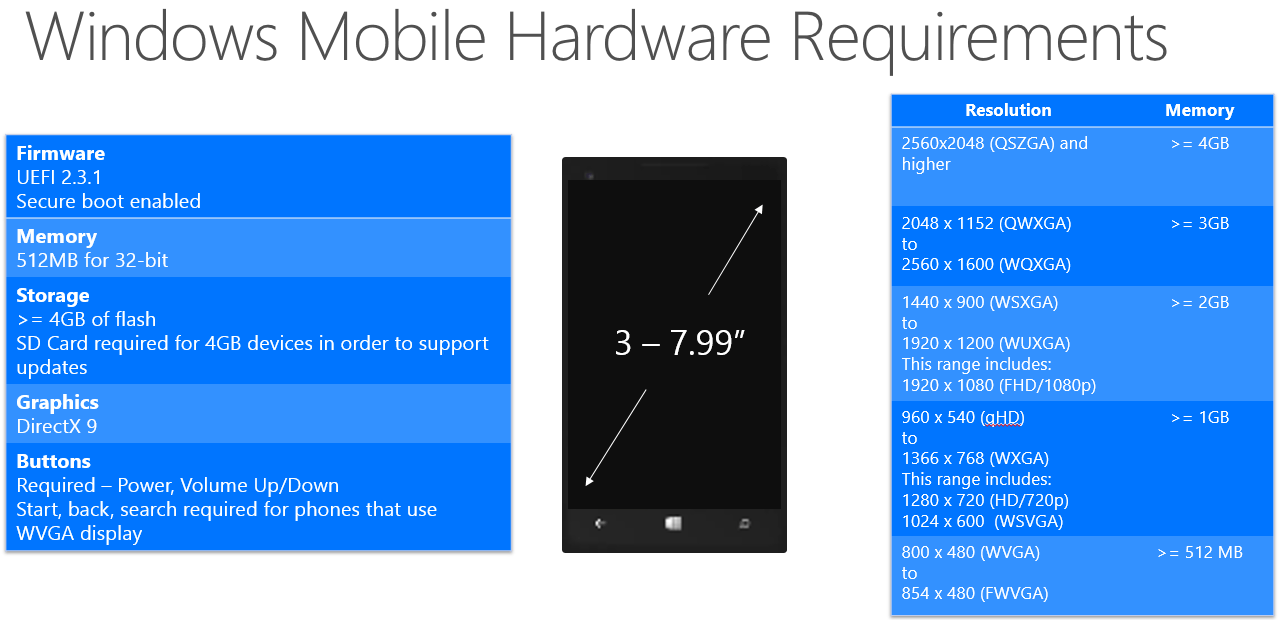
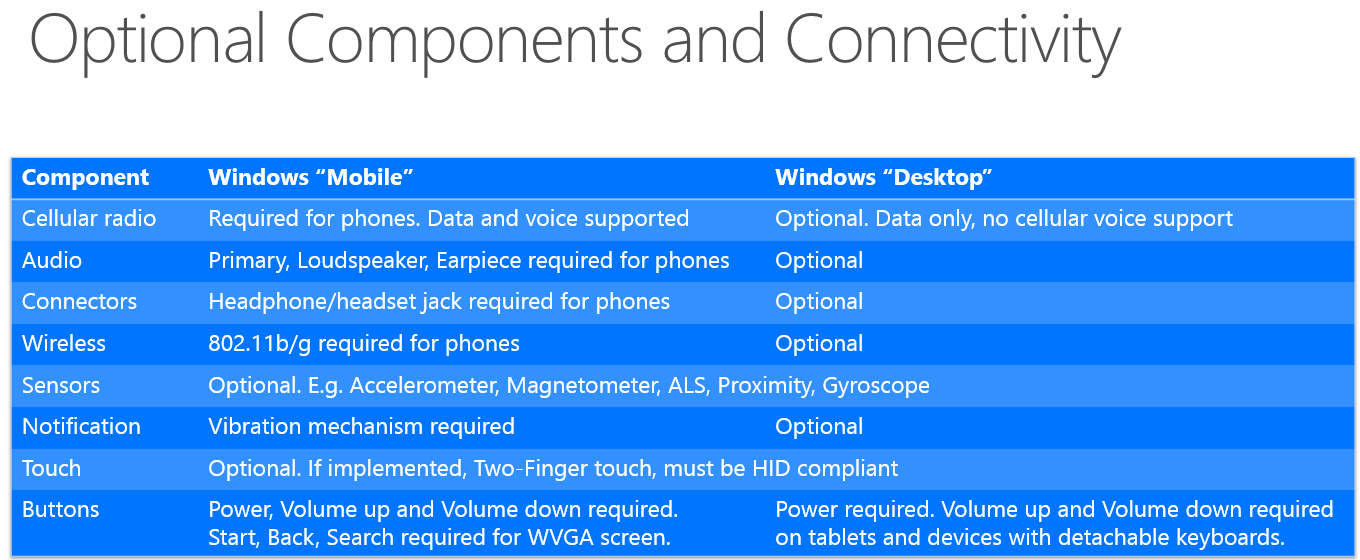
2.  Mobile requirements:

windows_10_mobile_hardware_requirements
  • RAM:512 megabyte (GB) (32-bit)
  • Storage: 4GB of flash
  • Graphics card: Microsoft DirectX 9 graphics device.
  • A Microsoft account and Internet access
windows_10_optional

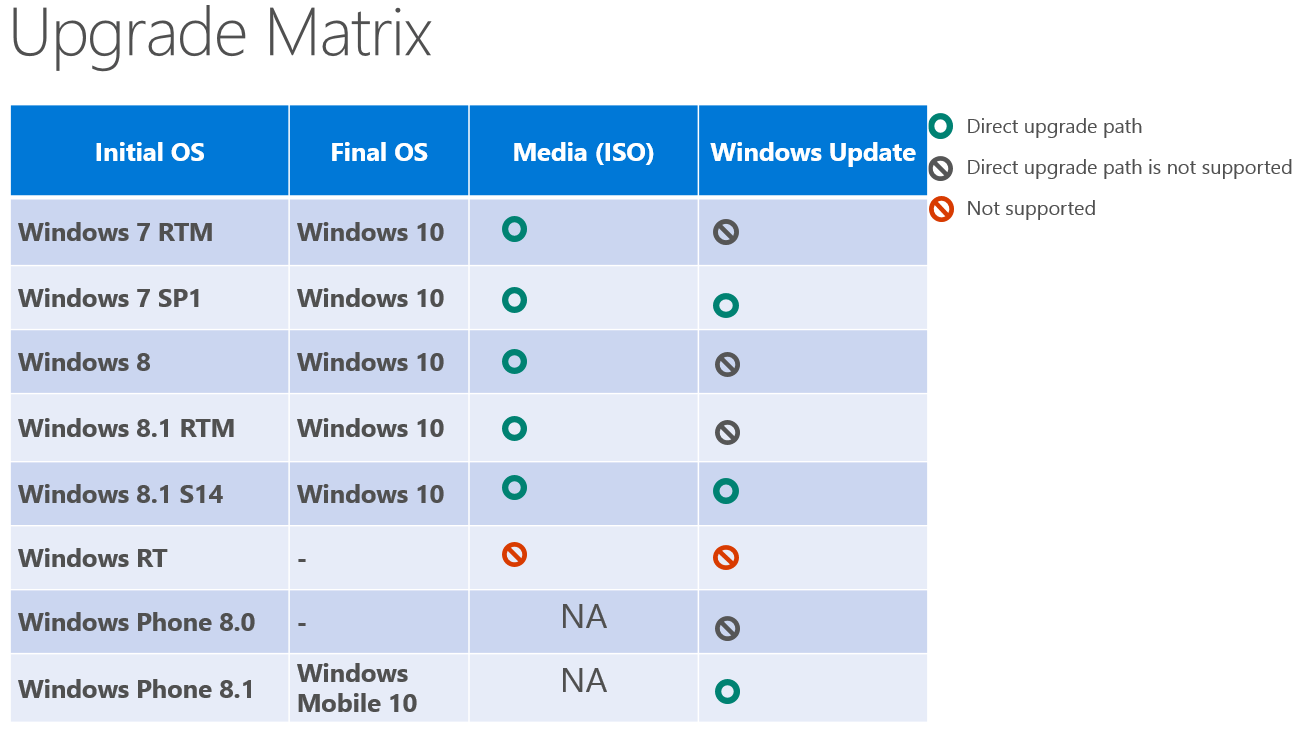
Upgrade paths:

windows_10_upgrade_matrix

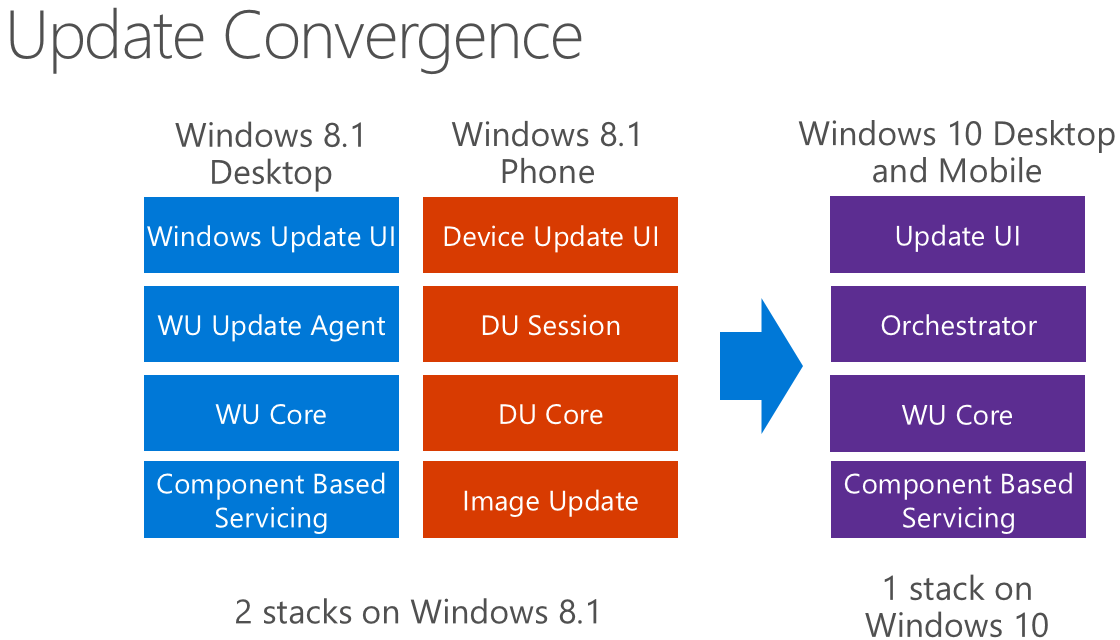
windows_10_update_convergence

Sunday, June 14, 2015

Microsoft reveals Windows 10 features that will be deleted in Windows 10 installation process


1.      Enterprise users can manage company-wide rollouts for Windows 10 updates.
2.      New Windows broswer 10 finally gets a proper name: Microsoft Edge.
3.      The operating system will be a free upgrade for Windows 7 and Windows 8/8.1 users during the first year.
4.      If you do not upgrade in the first year, you will be charged. There has been some confusion around pricing - but Microsoft is expected to charge a one-off license fee and NOT move to a subscription model.
5.      Windows 10 will launch in late-2015, likely by the end of July. The Technical Preview will end on 15 April 2015.
6.      Microsoft also debuted the 84in Microsoft Surface Hub and Windows Holographic. The latter will allow users to create 3D models via a custom-built HoloLens.
7.      Android and iOS apps will run on the new OS.


Monday, June 8, 2015

Pageviews

Followers

Powered by Blogger.

- Copyright © 2013 Selva Sharing -Selvasharing- Powered by Blogger - Designed by @ Access -